On 16 July 2026, inspectors walked into a shoe factory in Ho Chi Minh City on a tip from US Homeland Security Investigations. They counted 25,396 finished pairs carrying Nike and Air Jordan marks, plus thousands of uppers and soles still on the line. Eleven containers had already shipped to the United States. The detail that stuck with me sits near the end of Tuoi Tre's report: even the authentication codes on individual pairs had been copied from genuine shoes.
Read that twice, Instagram buyers. The tag everyone was told to trust is now part of the fake. Asia IP Law put the operation at almost 50,000 pairs in production, one of Vietnam's biggest raids. So we built SneakerAuth around one rule: no single detail gets to decide. It is our own AI legit check, it lives at legitcheck.snkrscart.com, it is free to start, and this is how it works under the hood.
Why We Built a Legit Check Shoes App, Not Another Guide
We already have a manual fake spotting guide, and in May we looked at AI legit checking as a category. Guides have one weakness. Factories read them too. Every time someone posts "check the heel tab stitching on the Panda Dunk", the next batch fixes the heel tab.
Anyone who has searched how to legit check shoes at 1 a.m., a stranger's UPI ID open in another tab, knows Indian buyers have it harder than most. Hyped pairs here move through Instagram DMs and WhatsApp groups far more than through stores. Back in 2021, Prabal Baghla, co-founder of Sole Search, told VICE that new resellers get followed and messaged by pages pushing fakes, and that stock sold as "unauthorised authentic" is hard to verify. Five years on, the DMs look the same. What changed is that a buyer can now ask for proof that takes a seller one minute to produce.
Five Photos, 93 Checks, One Live Code
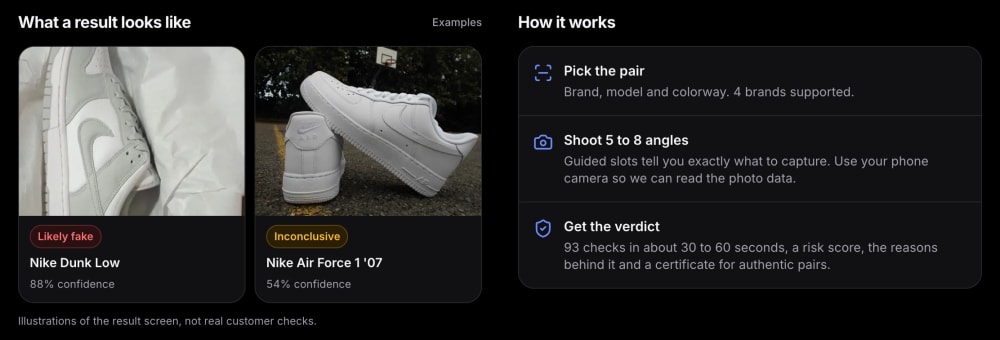
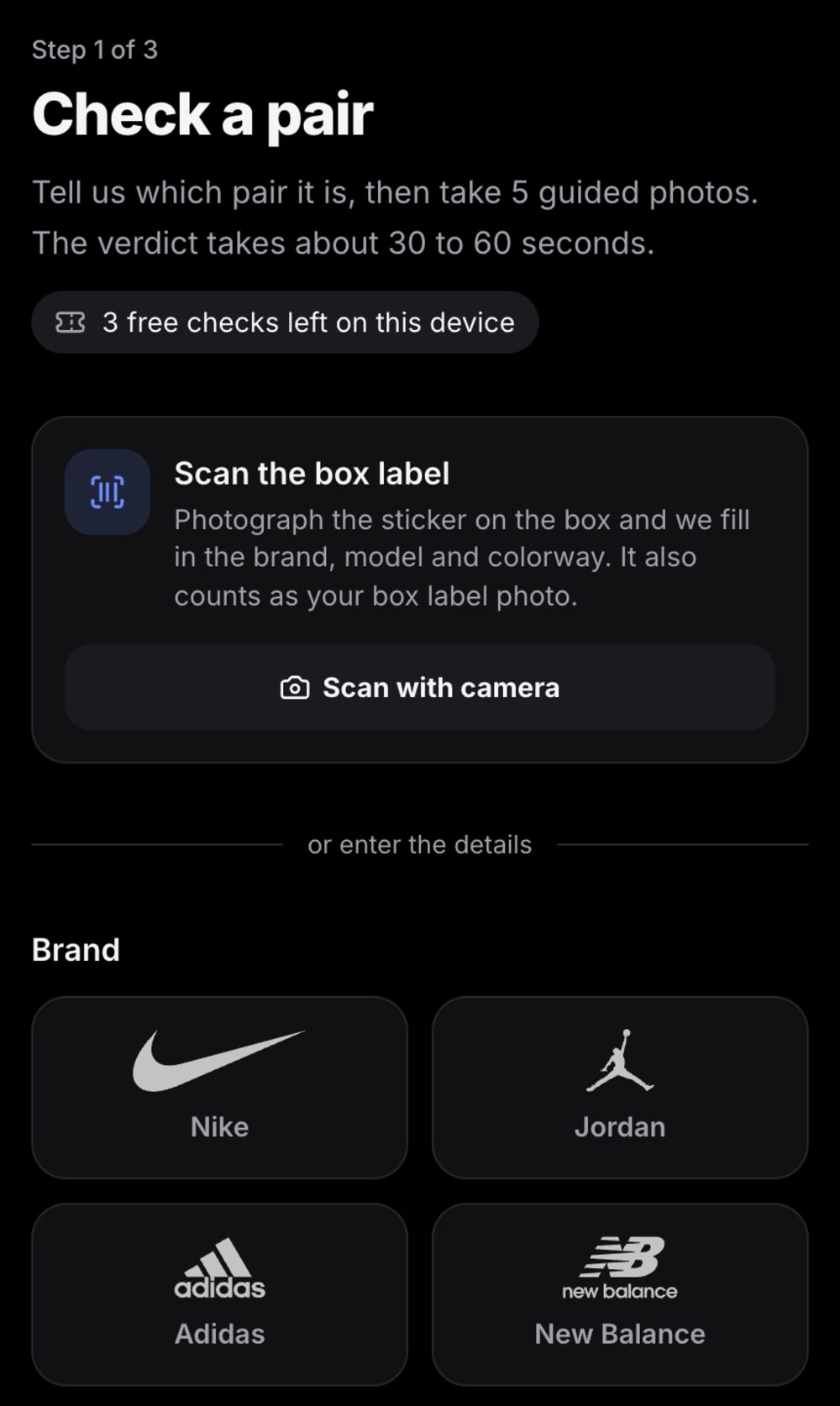
Start with the pair. Brand, model and colourway get typed in, or read straight off the box: point the camera at the sticker and SneakerAuth fills the fields itself, then keeps that shot as the box label photo. Five angles are compulsory. Outer side, inner side, top down, heel, sole. The tongue label, toe box and box label are optional, but skipping them is a mistake, since the size tag gets cross-checked against the sticker and its barcode.
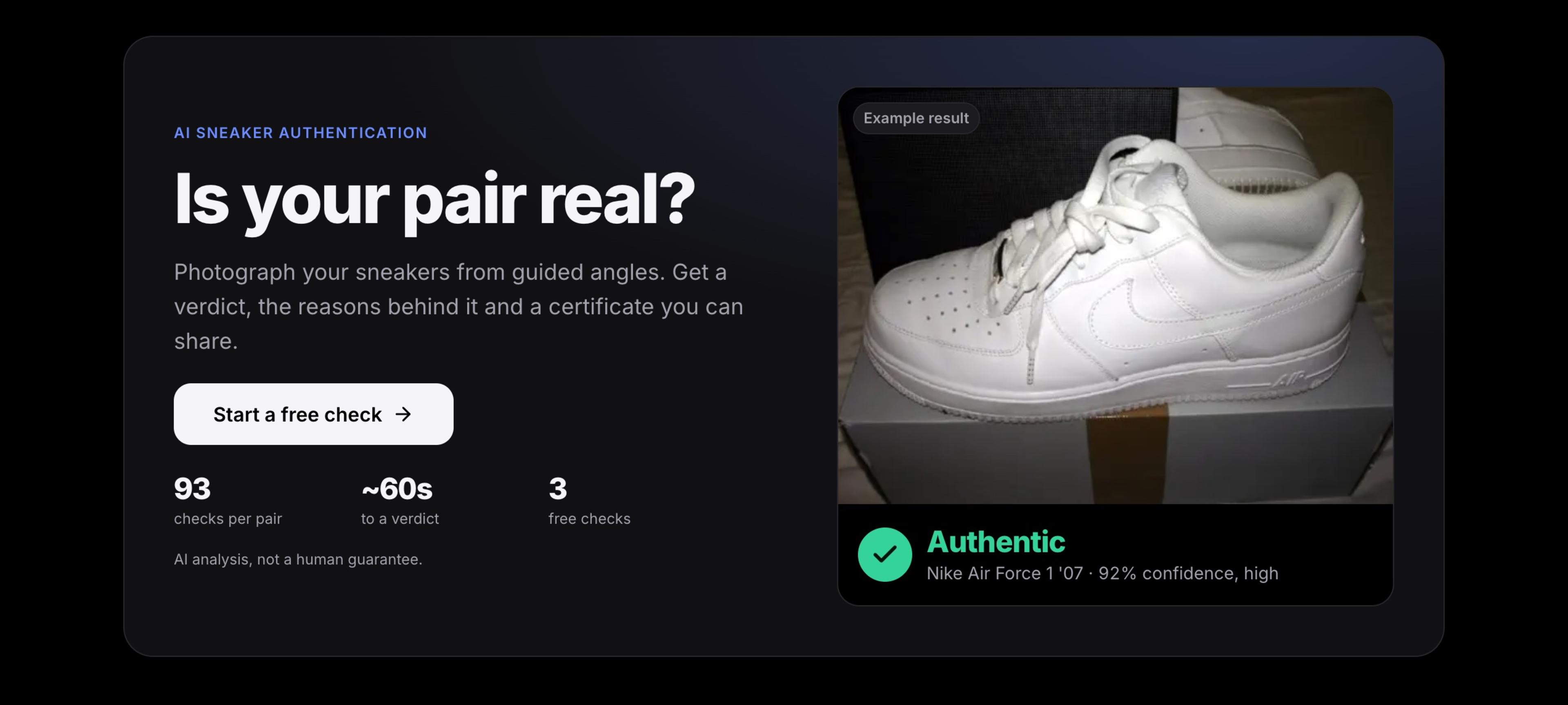
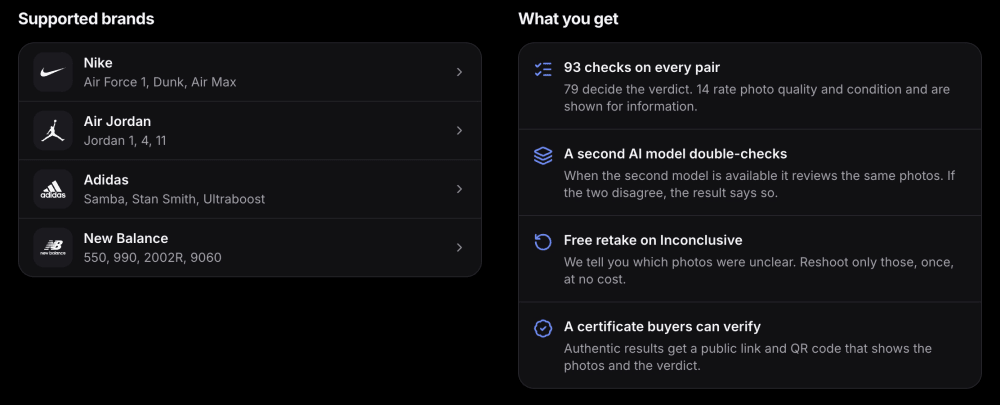
Those photos feed 93 checks in 20 categories. Seventy-nine of them decide the verdict, and they are the unglamorous details fakes get wrong: Swoosh and stripe proportions, stitch density, tongue label fonts, barcode and style code format, insole print, midsole detail, even the aglets on the laces. The last 14 are informational. Nine test whether the photos themselves are real; five grade condition, from sole wear to midsole yellowing. Expect an answer in 30 to 60 seconds.
Scoring is weighted, not a vote. A failed critical check, such as a style code that does not belong to the model, adds 40 risk points. A regular fail adds 10 and a warning adds 5. Reach 60 and the pair reads as likely fake. Between 30 and 59 it stays inconclusive. Below 30, with the photos agreeing with each other, it can come back authentic. Two critical failures, or a style code mismatch on its own, make it fake whatever the total says.
Why It Only Takes Live Photos
People push back on this part. No gallery uploads. No drag and drop, no screenshots, no forwarded WhatsApp images. The camera opens inside the page and shoots whatever pair is sitting in front of it.
The most common scam in Indian resale is simple. A seller sends clean photos of a real pair, and a different pair turns up at the door. Lifting ten good shots from another reseller's page takes seconds. So every check gets a short live code. Write it on paper, put it beside the shoe in the outer side photo, and the AI reads it back. The code is signed, it expires, and it works for one check only.
On top of that, each photo is compared with earlier checks to catch reused images, tested for signs that someone photographed a screen or a printout, and screened for AI generation, including the C2PA Content Credentials markers backed by Adobe, Google, OpenAI and others. Fail any of these and the verdict turns inconclusive. Never fake. A bad photo is not proof of a bad shoe, and we would rather ask for a reshoot than accuse a legit pair.
Two Models, and the Honest Word Inconclusive
After the first analysis, a second AI model reviews the same photos whenever it is available. If the two disagree, SneakerAuth says so and the result goes inconclusive. Plenty of apps bury that kind of doubt under a confident green tick. My take: hiding it is worse than useless, because a buyer with five figures on the line deserves to know when the machines are split.
Inconclusive is not a dead end, though. The result lists which angles were unclear. Reshoot just those, once, free, and the retake does not count against the three free checks. When a check does fail, the app shows the actual photo cropped to the spot the AI flagged, with a plain note beside it.
The Certificate Is the Feature Indian Resale Needed
An authentic result with a passed live code earns a certificate: a short ID, a public link and a QR code that shows the photos and the verdict. Anyone can open it without logging in.
Now flip it around. You are in Pune, the seller is in Delhi, and the pair costs more than your phone. Ask them to run a check and send you the link. A seller with a real pair loses two minutes. A seller with a fake, or with someone else's photos, has nothing to send. Honestly, if a reseller refuses a free check on a pair that expensive, you already have your answer.
What It Covers, and When to Go Further
Today SneakerAuth covers four brands: Nike (Air Force 1, Dunk, Air Max), Air Jordan (1, 4, 11), Adidas (Samba, Stan Smith, Ultraboost) and New Balance (550, 990, 2002R, 9060). Each has a fake detection guide listing the five or six tells that matter for that brand. Three checks need no account. After that, sign-in is a one-time code sent by email. No password, no card. The site also installs to a phone's home screen like an app, handy when meeting a seller outside a metro station.
The site says it plainly in its own footer: AI analysis, not a human guarantee. Take that seriously. For a general release Dunk or Samba, a clean authentic result with both models agreeing is a strong signal. For a grail collab, use it as the first filter, then get the pair checked in hand before money moves. Machines are great at consistency. A person holding the shoe still catches what a photo cannot, like weight, glue smell and how the suede feels.
The same thinking already runs on our own store. Every pair a seller lists on SNKRS CART goes through six live camera verification photos that our team approves before it ships. If you would rather skip the DM haggling entirely, browse what we have in stock.
Learn the tells, then let SneakerAuth run the 93 you would forget.
Example shoe photos on the SneakerAuth home page: Wikimedia Commons, CC BY-SA.